
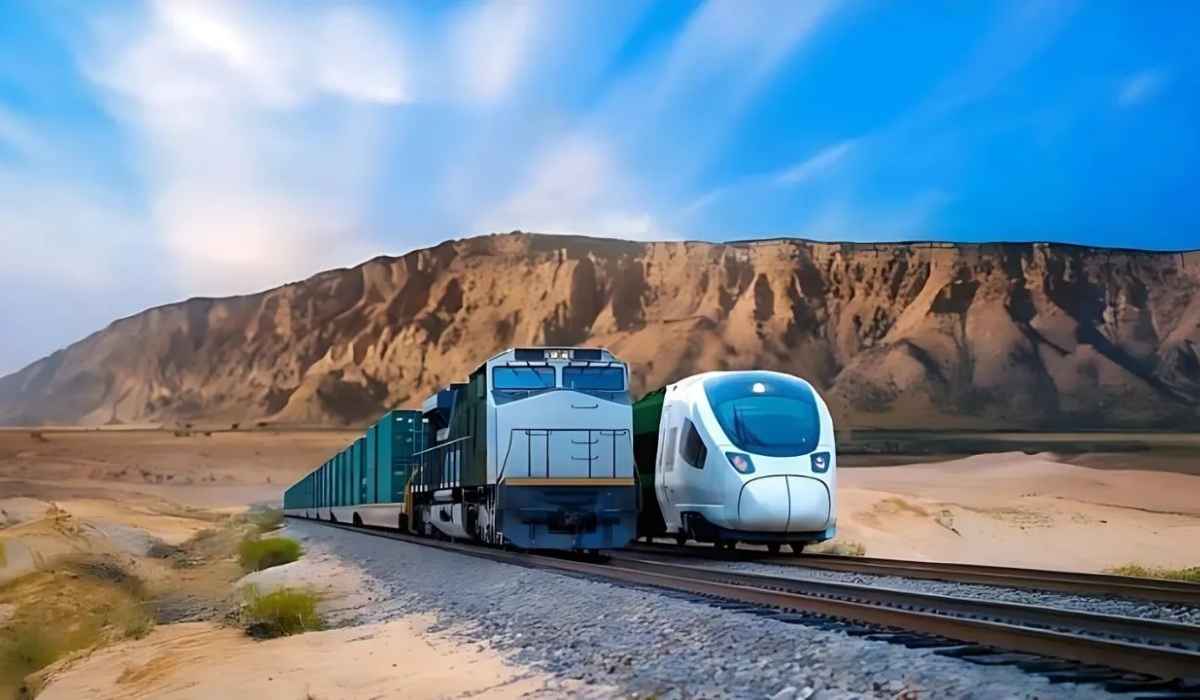
Hafeet Rail is a new joint rail venture that will connect Oman and UAE by train for the first time.
Named after Jebel Hafeet, the mountain straddling the UAE-Oman border, the project is advancing rapidly, and when complete, it will fundamentally reshape how people and goods move across one of the world’s most strategically important regions.
What is Hafeet Rail?
Hafeet Rail is a joint venture between three major partners – Etihad Rail (the UAE’s national rail operator), Oman Rail, and Mubadala Investment Company.
Its central purpose is to bridge the two countries’ transport networks by linking the Etihad Rail system at Al Ain with Sohar Port in northern Oman, creating, for the first time, a cross-border rail corridor in the Gulf.
The project is valued at approximately $2.5 billion and is a strategic milestone in establishing a unified transport and logistics network, offering both economic and social benefits to the two nations.
How far along is the Hafeet Rail project?
Construction began in 2024, and on April 21, 2026, it was confirmed that 40 per cent of the overall UAE–Oman rail connection has now been completed. The full network will span 238 kilometres along its main corridor, forming a vital artery between the two nations.
Active construction is under way across four key locations along the route – Al Ain, Al Buraimi, Sohar, and the Wadi Al Jizzi valley corridor.
What are the commercial benefits for the UAE and Oman?
Hafeet is a logistics and economic initiative aimed at connecting the UAE and Oman’s industrial and commercial sectors. Phase one links Sohar to the UAE’s national rail network, creating a unified transport system.
By connecting major cities, economic zones, and industrial hubs, the railway is expected to reduce freight costs, improve efficiency, and make supply chains more reliable for businesses in both countries.
Core commercial objectives
- Establishing a permanent, high-capacity transport link across a previously unconnected border
- Creating a unified, streamlined logistics platform serving the wider Gulf region
- Unlocking measurable social and economic benefits for communities in both countries
- Connecting more than 12 passenger stations, 5 major ports, and over 15 integrated freight facilities
How will Hafeet Rail benefit travellers?
Once operational, Hafeet Rail is expected to make travel between the UAE and Oman faster and more comfortable. Passenger trains could reach speeds of up to 200 km/h, offering a strong alternative to driving, especially with border delays.
The route will also pass through desert landscapes and the mountains around Jebel Hafeet, making the journey part of the experience for both residents and tourists.
Key benefits for passengers
- Dramatically reduced travel times on key routes (see journey times below)
- Modern, high-speed trains running at up to 200 km/h, a far smoother alternative to driving
- Improved accessibility for daily commuters, business travellers, and weekend visitors
- Elimination of queuing delays at road border crossings
- A boost to tourism, with both countries serving as natural gateways to each other
Hafeet Rail journey times and route details
The Hafeet Rail network runs from Sohar Port in northern Oman through to Abu Dhabi in the UAE, via Al Ain. The total track length will reach 303 kilometres, of which 238 kilometres forms the primary Sohar–Abu Dhabi corridor. The impact on journey times is dramatic.
Travel time reductions:
- Abu Dhabi to Sohar (via Al Ain): 1 hour and 40 minutes
(Currently takes about 3 hours and 25 minutes) - Sohar to Al Ain: 47 minutes
(Down from the current 1 hour and 27 minutes)
Train speeds:
- Passenger trains: Up to 200 km/h
- Freight trains: Up to 120 km/h